
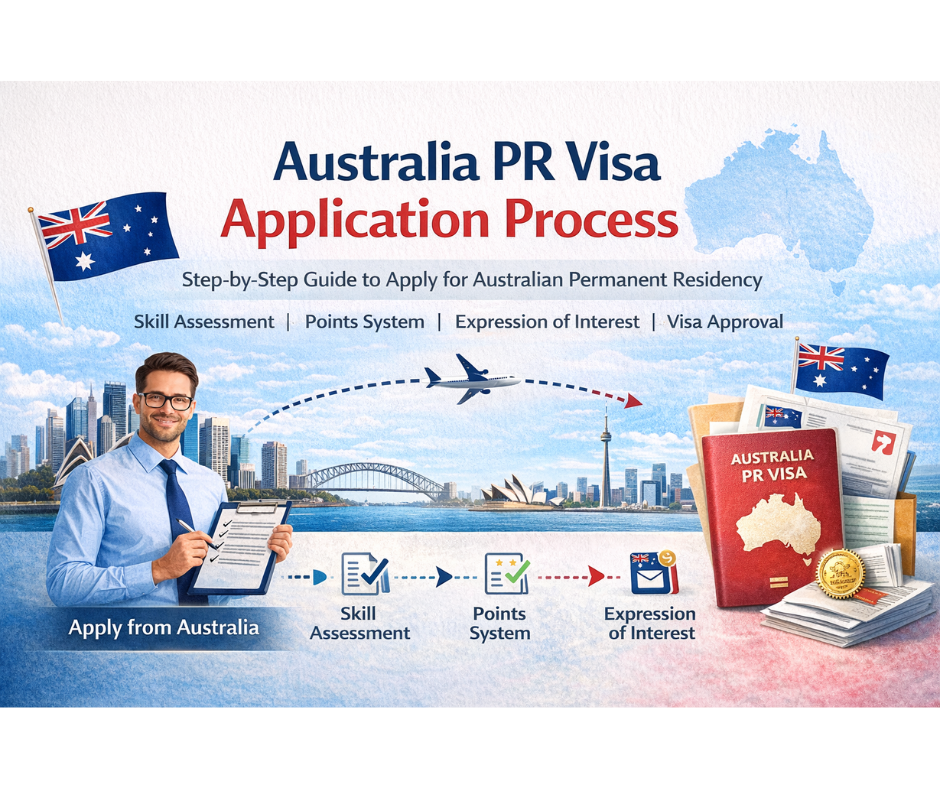
Australia’s Permanent Residency (PR) visa offers a life-changing opportunity: the chance to live, work, study, and build a future in one of the world’s most developed and multicultural countries. This guide walks you through the entire process in clear steps — from eligibility to final visa grant.
1. Understand What Australia PR Means
A Permanent Residency (PR) visa lets you stay in Australia indefinitely with almost all the rights of a citizen — including working, studying, and accessing government-funded healthcare (Medicare). After holding PR for the required period, you may also become eligible for Australian citizenship.
2. Choose the Right Visa Pathway
Australia offers different PR streams based on skills, sponsorship, family ties or special talents. The most common options include:
Skilled Migration Visas
Subclass 189 – Skilled Independent Visa (no sponsorship required)
Subclass 190 – Skilled Nominated Visa (state/territory sponsorship)
Subclass 491 – Skilled Work Regional Visa (regional pathway leading to PR after meeting conditions)
Employer & Family Pathways
Employer-sponsored permanent visas (e.g., Subclass 186)
Partner or family-sponsored visas
Choosing the right pathway depends on your profile, qualifications, and goals.
3. Check Your Eligibility
Most skilled PR pathways are points-tested. Points are awarded for:
Age
English language ability (IELTS, PTE, TOEFL etc.)
Work experience
Educational qualifications
Australian work/study experience
State nomination or partner skills
You typically need at least 65 points to be considered, but higher scores improve your chances of receiving an invitation.
4. Get Your Skills Assessed
Before you apply, your skills and qualifications must be assessed by a relevant Australian authority (e.g., ACS for IT, Engineers Australia for engineers, VETASSESS for many trades). This verifies that your qualifications are equivalent to Australian standards.
5. Submit an Expression of Interest (EOI)
Once eligible:
Create an ImmiAccount on the Department of Home Affairs site.
Submit your Expression of Interest (EOI) through SkillSelect.
Include details like your work experience, qualifications, points score, and chosen visa subclass.
Your EOI enters a pool of candidates — high-scoring profiles are more likely to be selected for an invite.
6. Receive Invitation to Apply (ITA)
If your EOI is successful, you’ll receive an Invitation to Apply (ITA) for your chosen PR visa. Once invited, you typically have 60 days to lodge your visa application online.
7. Prepare & Submit Your Visa Application
When applying, you must upload all required documents, including:
Valid passport
English language test results
Skills assessment outcome
Education certificates
Work experience letters
Police clearance certificates
Health and character checks
Incomplete or inaccurate submissions can delay processing.
8. Undergo Health & Character Checks
All applicants and dependents must complete:
A health examination by a government-approved doctor
Police background checks from all countries where you lived more than 12 months
These are mandatory for visa approval.
9. Wait for Visa Decision
The Department of Home Affairs assesses your application and may reach out for further information. Processing times vary by visa subclass and completeness of documents. Skilled PR visas typically take 6–12+ months.
10. Visa Grant & What Comes Next
If approved, you’ll receive your PR visa grant notice. With an Australian PR:
You can live and work indefinitely in Australia
Access Australian healthcare (Medicare)
Sponsor eligible family members
After meeting residency requirements, apply for citizenship
Remember to arrive in Australia by the date specified in your visa grant for it to be activated.
Processing Time & Costs — What to Expect
Processing Time
Processing varies by subclass and individual case:
Subclass 189: approx. 6–9 months
Subclass 190: approx. 7–12 months
Subclass 491: can take longer due to additional regional requirements
Indicative Costs
Visa application fees plus other costs (skills assessment, English test, medicals) can add up to around several lakhs INR / AUD thousands.
Tips for a Smoother Application
✔ Apply early and keep documents ready before submitting your EOI.
✔ Aim for higher English scores to boost points.
✔ Use only registered migration agents or authorised advisors to avoid scams or misinformation.
Avoid Immigration Scams
Be cautious of agents promising guaranteed PR visas. Fraudulent practices — like fake job offers or forged documents — are illegal and can cost you time and money. Always verify credentials and deal with registered professionals.
✅ Australia PR Visa – Document Checklist
Having documents ready in advance makes your application smoother and avoids delays.
Identity Documents
Valid passport (all pages)
Birth certificate
National ID (if applicable)
Recent passport-size photographs
Skills & Qualification Documents
Skills assessment outcome letter
Educational certificates (degree, diploma, transcripts)
Professional licenses (if required for occupation)
Employment Proof
Reference letters from employers
Salary slips / tax records
Employment contracts
CV/Resume
English Language Proof
IELTS / PTE / TOEFL test result
Health & Character
Medical examination reports
Police Clearance Certificates (PCC) from countries lived in 12+ months
Family / Partner Documents (if applicable)
Marriage certificate
Partner skills documents
Children’s birth certificates
🎯 Quick Australia PR Eligibility Snapshot
You may qualify if you:
✔ Are under 45 years of age
✔ Have an occupation on Australia’s Skilled Occupation List
✔ Obtain a positive skills assessment
✔ Score 65+ points in the points test
✔ Meet English language requirements
✔ Pass health and character checks
❓ Top FAQs – Australia PR Visa Process
1. What is the easiest way to get PR in Australia?
Skilled visas like Subclass 189, 190, and 491 are the most common PR pathways for qualified professionals.
2. How many points are required for Australia PR?
The minimum is 65 points, but higher scores improve invitation chances.
3. How long does the PR visa process take?
Usually 6–12 months, depending on visa type and profile.
4. Is IELTS mandatory for Australia PR?
Yes, most applicants must prove English through IELTS, PTE, or equivalent.
5. Can I include my family in my PR application?
Yes, spouse/partner and dependent children can be included.
6. Do I need a job offer for Australia PR?
Not for Subclass 189. Some visas (190, 491) may require nomination but not always a job offer.
7. What happens after getting PR?
You can live, work, study in Australia and later apply for citizenship if eligible.
8. Can PR be rejected?
Yes, due to incorrect documents, false information, health, or character issues.
9. Is skills assessment compulsory?
Yes, it is mandatory for skilled migration visas.
10. Can I move between states after getting PR?
Yes, but state-nominated visa holders should respect initial nomination commitments.